Tuesday, October 15, 2013

Huancavelica, once "the pillar of the Spanish empire"

We're at 12,000 feet in the Andes, in a town of about 40,000 called Huancavelica. The city is three hours drive from Huancayo, along twisting mountain roads with (gulp) amazing scenery.
Just to the south of town is the Hill of Santa Barbara, where is found one of the largest deposits in the world of cinnabar, a mercury ore.
It was mined for several thousand years by everybody up to the Incas for its intense red color, and when ground up, was used as a pigment, especially among royalty.
However, when the Spaniards took over, and a process for refining silver that used mercury was invented, the city became immensely important and well off, hence the cathedrals and other signs of old wealth.  (By the way, this is being written behind the second big window on the second floor of the hotel to the left of the church on the main square.)
 
However, the mines themselves were quite dangerous because of the geology of the area and the dust of the mercury ore, and the Santa Barbara Mine became known as "The Mine of Death."
As the production of ore tailed off in the mines, and the worldwide use of mercury declined due to the recognition of its hazards, the Santa Barbara Mine was finally shut down in1974, but only after the production and shipping of an estimated near-100,000 tons of mercury.
Today, little remains of that mercury dynasty, save some areas with significant contamination, a fascinating history, and shuttered mine entrances.
Despite its spectacular surroundings and a charm shared by few towns in the region, Huancavelica struggles economically, and is reputed to be among the poorest cities in Peru.
OK, not such a humorous entry, but an interesting, beautiful area with a complicated past.  And it was time that you actually learned something.
Dave & Paula

Friday, October 11, 2013

Nourished, er, rather, injured by the Word of God

One of our very good Elders was helping to unload boxes of copies of the Book of Mormon, and the corner of one of the boxes struck his left thigh a heavy blow.  
Like most young men, he brushed it off and continued working.
However, over the next several days, the thigh swelled and became very painful.  He apparently had bled in to the muscle, and is requiring some heavy pain medications.  To his chagrin, he has been ordered to inactivity for a week to allow some recovery.
I suppose one could be injured by less worthy objects, but the poor guy has been in a world of hurt.
We hope that your experiences with the Book of Mormon are more enjoyable.
Dave & Paula

Friday, October 4, 2013

They start 'em young here

May I say it again?  Drivers here in Peru are bad.  Period.  There is little wonder that the roadway accident and death statistics are the worst in South America.
Pedestrians are especially at risk, as they are given no leeway whatsoever.  I have tried several times while driving to wave them to cross the street at appropriate times.  They just stared at me like I was the alien that I am.  ("Crazy gringo! Doesn't he know that his manhood is in now in question?!") 
So, Paula, feeling a little suicidal. was out for a stroll the other day, and in preparing to cross the street - on foot, mind you - she looked carefully up the one-way street.  All was clear, and as she stepped out to cross, a kid on a bicycle slammed in to her.  Nothing serious, but she realized that bad driving habits here start even before they get behind the wheel.  Like, when they are behind the handlebars.  
We hope that you're wearing your helmet also when you go for a walk.
Dave & Paula
P.S.  When are they coming out with those air bags for pedestrians?  Probably won't make it up here from Lima for a while...

Friday, September 27, 2013

Rompemuelles!

OK, you're in a poor country, everyone drives as if they left their brain at home, the major 'highways' are two lanes and run smack through the middle of tiny pueblos, and the police are nowhere to be seen.  How do you keep the speed down?  Easy!  Rompemuelles!
"But that's just a speed bump!" you say.  Hah!  "Just" a speed bump?! They are called "spring breakers" for a reason.  The Peruvians take perverse pleasure in building them tall and steep.  
And frequent.  On one trip, we counted them between Huancayo and Tingo María, a town in the jungle.  I guessed 75.  One Assistant guessed 100.  Sister Henderson guessed 200, and she won the contest, at 153 total.  That's a lot of dang rompemuelles.
They are usually heralded by a sign like this:
Or this.  Actually, I'm not sure whether this was to warn of an upcoming bump, or whether it is the name of a town.  Maybe that's where the factory is located.  I dunno.
I say "usually" they are heralded by such a sign, but at times there is no warning, and no painted stripes. Instead, I think I've seen a bunch of Peruvian rompemuelle makers sitting in the bushes giggling, waiting for the unsuspecting motorist to have his springs not only broken, but torn clean out of his undercarriage.  
We hope that your muelles don't get rompe'd!  Or at least that you win the bet.
Dave & Paula

Thursday, September 19, 2013

Another small victory

Those of you who have known us for a while are aware that we have ridden bicycles forever.  Ever the optimists, we brought a couple.  Then we met the roads of Perú.
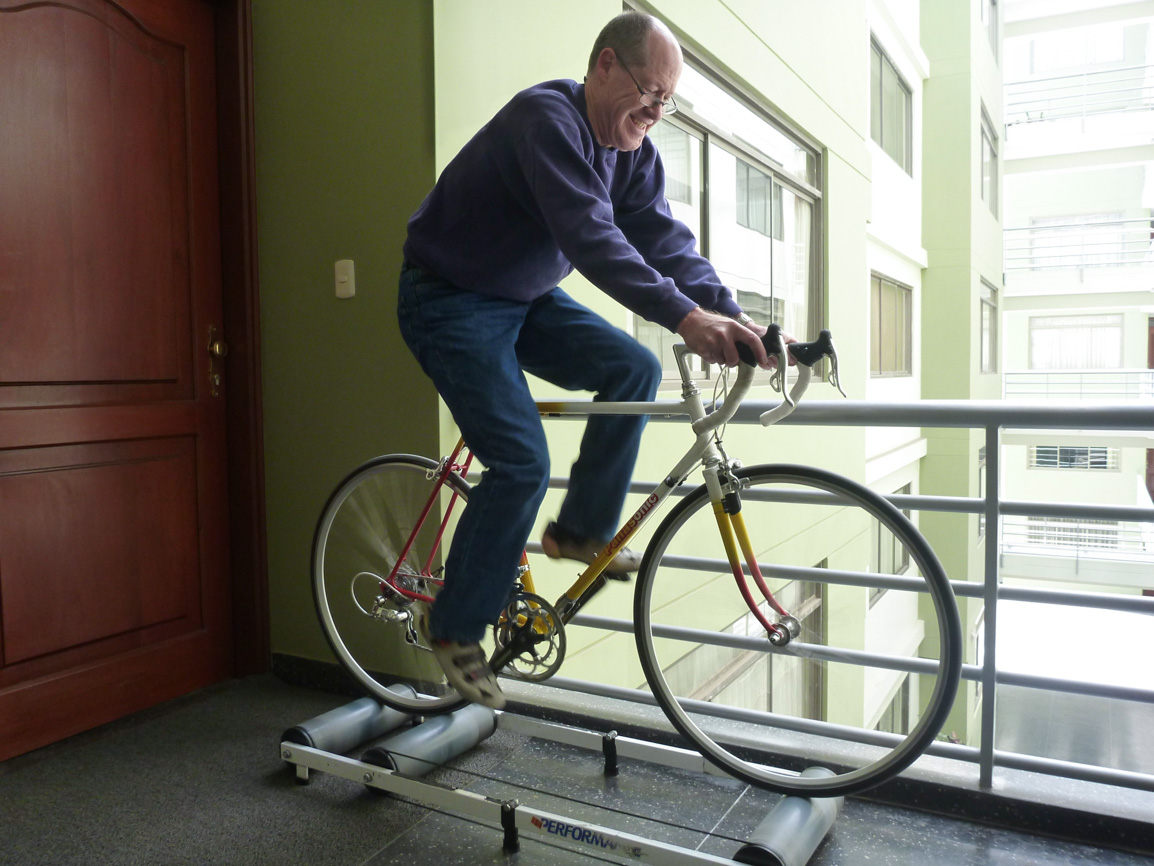
Having an inkling that we might not be able to pedal happily around the Mission, we also brought a set of "rollers," an amazingly old way of using a normal bike in one place to get exercise.  The bike is not attached, and has to be ridden on top of the rollers.  One can only imagine the hilarity of riding off the side at full tilt, or having a three year old walk by with a loose blanket, and...
So we brought our old set of rollers just in case.  However, after only 23 years of use, a couple of the bearings had gone bad.  While yes, this gives more exercise, the noise was pretty loud, and when I would ride in the mornings in the cool stairwell, it would almost (almost, mind you) drown out the noise of the noodle-brained taxi drivers honking their horns, or the music someone insists on playing loudly at that hour.  It's not even good music.
So, with Carlos Llacsas along for advice, I went looking for bearings.  He advised me to head down in to the auto parts section of town, where the usual warren of hole-in-the-wall shops are located.
He also wisely advised that I park on a well-traveled street, where the easily-removed parts of the car, as well as some of the not-so-easily-removed parts of the car (engine, transmission, etc.) might not quickly end up in one of the local shops, where I'd have to ransom them back.
I've got to admit, pulling the tools out of the shipping boxes and tinkering with something to fix was fun.
 A Dremel tool?  Duh!  Gotta bring the Dremel!
 The test ride proved the value of the repair.
I could now hear the idiot taxi drivers honking their horns for no good reason!
We hope that all your Preparation Day projects are so successful, and that you can find your rear-view mirrors to buy back.
Dave & Paula

Thursday, September 12, 2013

Not actual Peruvians

So, when you are a foreigner in Peru, you have to go to Lima and get a carnet de extranjería, or in other words, an ID card identifying you as living here, but that you're not a real-live Peruvian.  That means that you do not have certain privileges belonging to real citizens, such as driving like a complete and total idiot, or urinating in broad daylight against any public structure that you'd like.
And while I may be crazy, I am not stupid, and this is NOT my card.  It's Spencer Anthony Somebody's.
In order to get your foreigner ID card, you have to go to Lima.  You say that you are going to live in Arequipa?  Sorry, you have to go to Lima.  Iquitos, 500 miles away in the jungle?  Lima.  Bora Bora?  You got it - Lima.  So off we went to Lima.
There are two ways to get there from Huancayo, if you don't count the train or backpacking.  The bus, with its eight hours of fun (see under, "Bus Accidents, Peru"), or by taking one of the two flights per day from Jauja ("How-Hah!") both going to, you got it, Lima.
OK, I admit it; that's not the real plane, but it's only about three times that big, hauling 21 passengers. During the 45-minute flight up and over the Andes, you are offered peanuts and Inca Cola by the kind flight attendant.
So, you finally make it to Lima to get your foreigner ID.  Luckily, a very nice lady employed by the Church had everything arranged and expedited so the first visit went relatively smoothly.  We even had time to get a picture taken at the grand plaza in the center of Lima.
Excuse me, excuse me, did you say THE FIRST VISIT?!!
Yes, that's right, there's a SECOND VISIT that you have to make several weeks later that takes about five hours, just long enough to have to stay overnight to catch the flight back to Jauja.  But, you might say, I still live in Bora Bora.  Sorry, Lima it is.
So, we are now officially not Peruvians, and so have none of the rights thereto appertaining.
We hope that you get to go to Lima sometime also.
Dave & Paula.

Saturday, September 7, 2013

Is there a hyphen in Obsessive Compulsive?

Maybe it's because she is employed for 24 hours per week, and we live in a small apartment at the moment, and there's only so much to do.  Our beloved ama de llaves (housekeeper/cook) Lilly Nancy Gomez tries hard to find things to do after everything is already spotless and cooked to perfection.
I will admit that my reading glasses have never been in such good order.
 If those pillows are a millimeter out of whack, it's probably because the ruler is no good.
Dust would not dare settle here, despite being endemic in Huancayo.
We hope that your ama de casa is half as obsessive.
Dave & Paula